under construction

under construction

September 9, 2011

One for the Record Books

In an attempt to be as optimistic as possible that the Bulldogs could conceivably beat the Gamecocks tomorrow, I am reminded of a time when Georgia, armed with perhaps the best quarterback in the nation, entered a South Carolina game seemingly full of confidence, and rightfully so.

After a 5-6 losing year, Coach Ray Goff's Bulldogs came to Williams-Brice Stadium to open the 1994 season ranked 24th in the nation, featuring a Heisman-candidate senior Eric Zeier, possessing a defense under Marion "Swamp Fox" Campbell that was thought to only get better from the year before, and were a near-touchdown favorite to defeat the 'Cocks and first-year coach Brad Scott in their own backyard.

During a time when South Carolina had some success against Georgia, winning four of seven games from 1988-1996, the Gamecocks would hold their own on this night as well, turning a perceived Bulldog cakewalk into a true dogfight:


Zeier was absolutely sensational against the 'Cocks, completing 31 of 51 passes, including three TDs and no interceptions, for 485 yards, while breaking the SEC record for most yards passing versus a conference foe.  Zeier's yardage mark still remains the second-most in school history, only behind the SEC-record 544 he totaled against Southern Miss the season before.

Just several years removed from Coach Dooley's three-yards-and-a-cloud-of-dust offense and only a couple after Garrison Hearst rushed for 1,500+ yards, it was almost difficult to comprehend, at the time, a Georgia offense throwing the football seemingly on every down.

At South Carolina, the Bulldogs rushed just 20 times of 71 total plays and that included running on the final six snaps of the game (the final four by true freshman Hines Ward).  For the entire '94 season, with future NFL superstars Terrell Davis and Ward in the backfield, Georgia would rush the least amount of times of any Division I-A team in the nation.

Quarterback Eric Zeier was just that valuable to the Bulldogs.

I shudder to think how dismal those 1993 and 1994 teams, who combined for just an 11-10-1 record, would have been without Zeier and his talented band of receivers: Brice Hunter, Hason Graham, Juan Daniels, Jeff Thomas, and tight end Shannon Mitchell ('93).

Georgia's offense had to be fast-paced and proficient as the team's defense was quite inadequate.  In fact, in allowing 394 yards and 26 points per game, Swamp Fox's '94 defense was actually more inferior than the defensive unit from the year before and is arguably the worst in school history.  Nevertheless, it did come up big and save the day with Corey Johnson's interception in the final minutes to defeat South Carolina. 

Watching this game also reminded me of the infamous snub Georgia endured at the end of its year.

The Bulldogs finished the '94 regular season with a 6-4-1 overall record, while South Carolina was slightly worse at 6-5, plus, Georgia had defeated the Gamecocks.  However, when the Carquest Bowl was looking for an SEC team, its invitation was extended to not the Dawgs, but the 'Cocks.

Granted, the bowl figured that likely more USC than UGA folks would travel to its Miami location, but rumor had it that the Bulldogs did not get the invite primarily because of a single player.  With the threat of Zeier, who suffered a knee injury in the season finale against Georgia Tech, not being able to play in the postseason, the bowls, particularly the Carquest, shied away from the Bulldogs, leaving them at home for the holidays.

Seems the bowl game would have rather featured one of the greatest college football quarterbacks of all time rather than a freshman Mike Bobo under center for the Dawgs.  Again, the record-breaking Zeier was just that valuable.

September 5, 2011

A Must-Win

The last time Georgia started a football season with an 0-2 record, it
wound up being a long, losing year for Mike Bobo and the Bulldogs.

As I watched Boise State dink-and-dunk Georgia's defense to death Saturday night, my primary thought was the exact same as one I had last November when it was first announced the Broncos were replacing Louisville as the Bulldogs' season opener: a loss to Boise wouldn't be too bad, but then to follow it up with a setback to South Carolina would be disastrous. 

Including this very morning, I continue to hear those who declare that even if Georgia was to lose to the Gamecocks, dropping to 0 and 2, the way the schedule is laid out, it could still be a respectable season for the Bulldogs in 2011. 

I couldn't disagree more.  Instead, in my opinion, Georgia must do something this Saturday it has only achieved once in its last eight attempts - defeat an AP-ranked opponent - and just one time in its previous seven  tries - win a game in an underdog role.

In the previous 117 seasons of UGA football, 11 of them began with losses in the first two games, including two in recent memory (1993 and 1996). Of those 11 seasons, only one ended in a winning season for Georgia, and even that was just a sub-par 6-5 record in 1979.

I strongly believe if Georgia was to start 0-2 for the 12th time in its history this Saturday, the best the Bulldogs would do this season (and I mean the very best) is a 7-5 record.  And a mere seven-win campaign likely translates to the program seeking out a new head coach come December...

In the wake of the Broncos handling of the Bulldogs, I tried to recall other schools that had started a college football season 0-2 but finished in fine fashion.  I came up with several off the top of my head, interestingly, all coming within a few-season span: Michigan in 1988 (finished ranked 4th in nation), Florida State the next season (10 consecutive wins to end year), Alabama in 1990 (started 0-3 but won seven of last eight regular-season games to reach Fiesta Bowl), and Penn State the same season (nine straight wins to close regular season).

What did the aforementioned football programs from 20+ years ago have in common?  Prominent head coaches Bo Schembechler, Bobby Bowden, Gene Stallings, and Joe Paterno were all supported by top-notch assistants, whose players were disciplined, fundamentally sound, and filled with intensity, or features evidently missing from the Bulldog teams the last few years and apparently the other night in the Georgia Dome.

In a season of supposed change, Georgia looked like the same old Bulldogs against the Broncos as, among other things, the offense couldn't stay on the field while the defense couldn't stay off of it.  Boise State ran 71 plays to the Bulldogs' 60 and possessed the football for more than seven-and-a-half minutes longer.

In Georgia's last six games against FBS opponents, beginning with Kentucky a year ago through last Saturday (excludes Idaho State), the Bulldogs averaged just 59 plays to the opposition's 75 and a time of possession of roughly only 27 minutes to the opponents' 33.

Like Georgia's previous 0 and 2 seasons of the past, there would be no rebound this year if the Bulldogs were to also lose their first two games, but a continuation of a program crumbling.  Although, this deterioration can be halted, at least for the moment, with a victory in a must-win situation this Saturday.

The Boise State meeting may have been one of Georgia's biggest season openers in its football history; however, South Carolina is the biggest game period during the Coach Richt era and for the Bulldogs in a long time, considering a loss would result in possibly another losing campaign and a long, long season...

August 31, 2011

Crowell Would Be in Rare Company

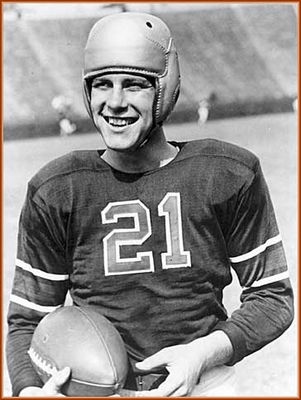
This Saturday, Isaiah Crowell could make history, joining pictured Danny Ware and just
four other Georgia running backs by starting a season-opening game as a true freshman.  
With the season opener only days away, apparently tailback Isaiah Crowell is in position to start against Boise State, but the question still remains (at the time of this posting) if he will or not.

Crowell figures to get the load of the carries against the Broncos, so it really doesn't matter whether he is in the lineup or not when the Bulldog offense first takes the field.  However, if the true freshman does happen to start on Saturday, he'll be given an opportunity very few players have experienced at Georgia.

In 2004, Danny Ware became the first true-freshman tailback/halfback to start a season-opening game for the Bulldogs in 61 years.  In a 48-28 win over Georgia Southern, the newcomer shined, rushing for 135 yards on 18 carries and three touchdowns.

For decades, Georgia's Charles "Rabbit" Smith was given credit to starting at one of the two halfback positions as a true freshman in the 1943 season opener against Presbyterian.  Smith rushed for 87 yards and a touchdown on just five carries, caught two passes, and also intercepted two passes on defense; however, it was in a reserve role.  In actuality, it was another freshman, and not "Rabbit," to start the game for Georgia at running back.

Against Presbyterian, according to newspaper accounts and the official NCAA statistics sheet, Bobby Hague started at quarterback for Georgia, Bill Poole at fullback, Edgar Bratton at wingback - all merely true freshmen and for good reason - while Johnny Cook, another 17-year-old newcomer, started at the Bulldogs' tailback position.
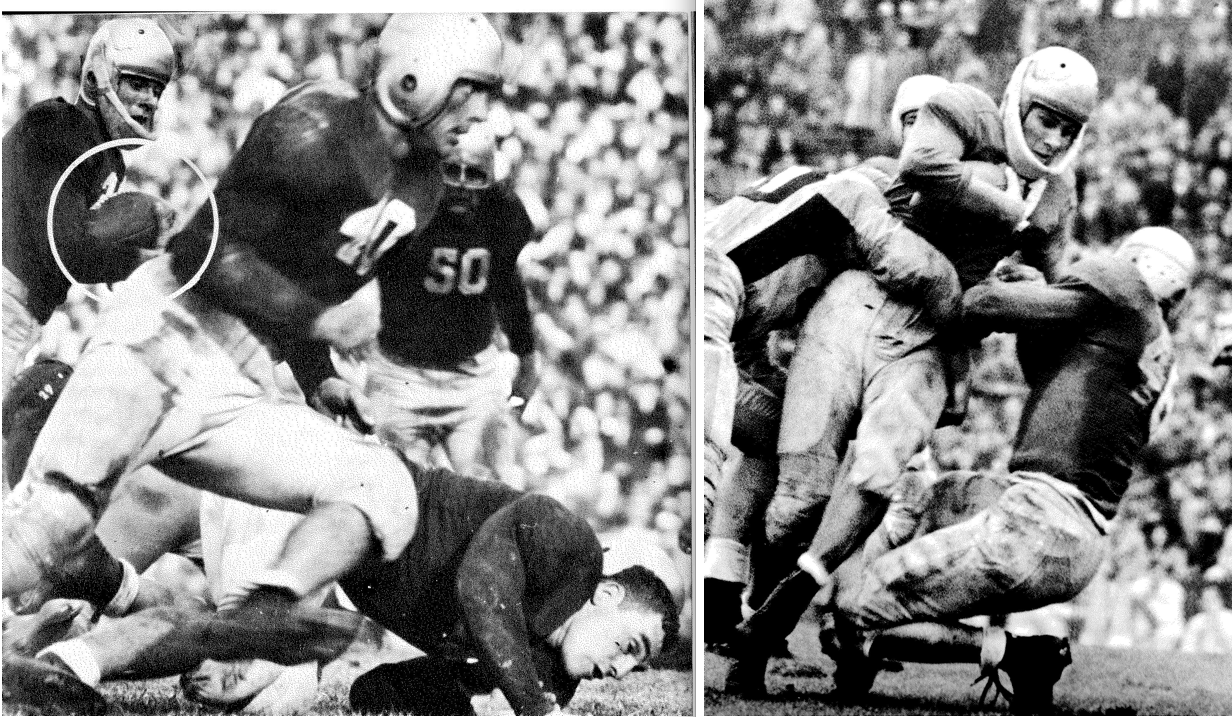
Including Johnny Cook (center with dark jersey),
every Bulldog true-freshman running back has scored
at least one touchdown in a season-opening start.

In a year he'd lead the nation in passing, Cook completed 12 of 20 passes for 143 yards, one touchdown, and no interceptions.  He also rushed for a touchdown, returned four punts for 50 yards, punted eight times, and made what would be an SEC single-game record four interceptions in a 25-7 Georgia upset victory.

As mentioned, it would be more than six decades later that another Bulldog true-freshman running back started a season opener for Georgia after Cook did so for the first time in nearly a quarter-century.

In the history of UGA football, on the whole, it has been somewhat difficult for a true freshman to play, much less start at a skill position for the first game of a season. 

Beginning with the inception of the sport at the school in the 1890s until the early 1900s, Georgia teams were primarily made up of juniors, seniors, and students of the university's law school, many of whom had played football as undergraduates at other schools.

During the 1920s, UGA's freshman football program began and for the next fifty years, besides the wartime seasons of 1943 and 1944, rarely a Bulldog frosh saw playing time.  Starting after the Korean War and until 1972, no newcomer saw the field as freshmen were ruled ineligible to play by the NCAA.

That leaves only a few windows of time for first-year players to see varsity action.  In fact, if Crowell was to start this Saturday, it would be only the sixth time (by my count) in 118 season openers a true freshman has started at running back for the Bulldogs.  Prior to Ware and Cook, the other instances:

KARL BOHREN (1920): In the season opener of the 1920 - a 40-0 rout of The Citadel - true freshman Bohren got the start at left halfback.  The "speedy" newcomer scored the final touchdown of the game on a 30-yard rush.  A week later, there was talk of Bohren moving to quarterback, but towards the end of the season, he remained at halfback as a reserve, where he scored two touchdowns against Florida.  Bohren's start in his very first game would also be the last start in his only season at Georgia.    

BOB McWHORTER (1910): McWhorter had plenty of practice for varsity play prior to coming to UGA.  While playing for Barnesville's Gordon Institute, a prep school before becoming a college, McWhorter scored versus Georgia Tech's varsity squad in a game in 1909 and played baseball against Georgia that spring.  Nevertheless, the native Athenian was regarded as a first-year college freshman for the 1910 Red and Black, and considering Georgia returned just five players from a 1909 team that officially won just one of seven games, the newcomer was promptly also regarded as a starter.

Starting at left halfback against Locust Grove, a football legend was born as McWhorter scored five touchdowns in a 101-0 blowout.  The following week against his former school, Gordon, McWhorter scored seven more touchdowns playing the right halfback position, where he'd remain and start at  the rest of his Georgia career.  McWhorter would eventually become the school's first All-American and my opinion of the Bulldogs' most valuable football player of all time.       

JOHN COX (1909): Freshman Cox, from Gainesville's Riverside Military Academy, arrived at UGA known more for his talents on a baseball diamond.  However, because the struggling football program was in dire need of gifted athletes, Cox was promptly practicing in the Red and Black's backfield.  Against the Atlanta Olympians in the first game of the 1909 season, Cox started at left halfback and scored the contest's only points on a five-yard touchdown run in a 5-0 Georgia victory.  Notwithstanding, his "true-freshman opening-game start" is in somewhat need of an asterisk...      

I've indicated before the fact UGA currently does not (but perhaps will in due time) acknowledge the contest against the aforementioned Atlanta club team, and three others mistakenly excluded, in its official records.  Presently, a 0-0 tie with The Citadel is officially recognized as the '09 season-opening game. 

Although Cox played during both the 1909 and 1910 seasons, scoring four total touchdowns while starting off and on at halfback, it is unclear if he actually started for the official season opener of '09 against The Citadel.

August 24, 2011

Simply Red

Upon the unveiling of the new football uniform last Saturday, a portion of the Bulldog Nation was simply appalled.  I, for one, expecting what had been circulated about a month or so ago, felt the new attire, besides appearing very red, actually looked worse than what had been rumored.  Red tops AND red britches?!?

As a kid, I enjoyed those handful of times during the 1980s when Georgia wore its red pants with white jerseys; it was a nice change from the norm and something different (yet not nearly as different as the new uniform...not even close). 

Although resulting in defeat, perhaps the most intriguing and exciting red-britches Bulldog game was the 1987 Clemson contest.  The Dawgs and Tigers met in Death Valley both with 2-0 records; Georgia was ranked 18th in the AP Poll while Clemson was 8th. 

Adding some color to the contest, both squads entered wearing their alternate pants: Georgia donning red instead of silver, Clemson in orange instead of its common white.  Dressed in their red britches, the Bulldogs had not lost a game in seven consecutive tries while the Tigers were 11-1 since debuting their orange pants in 1980.  Something had to give...


Coach Danny Ford got his wish as the Tigers would indeed "quit playing Georgia for a while."  When the Bulldogs added a seventh conference game in 1988 (and an eighth four seasons later), the yearly Georgia-Clemson football rivalry came to an abrupt end as the schools would meet just six times over the next 24 years.

In 1987, the Tigers ended the annual series in heart-breaking fashion as placekicker David Treadwell beat Georgia with a field goal in the final seconds for the second consecutive year.  Albeit in defeat, a few relatively fresh-faced Bulldogs stood out among the rest.

In his first and only season at Georgia, senior cornerback Mark Vincent intercepted his first pass as a Bulldog at Clemson.  After three years at SMU, Vincent had left the Mustangs for Athens after the program had received the much-publicized "death penalty" from the NCAA.  Vincent tallied two more interceptions two weeks later at Ole Miss, became an instant leader of Georgia's defense, and in my opinion, is one of the Bulldogs' all-time One-Hit Wonders.

Although receiver/returner Nate Lewis had played sparingly his first two seasons at Georgia and had never returned a punt, he emerged in the preseason of 1987 as the team's primary punt returner.  Highlighted by the 76-yard touchdown against the Tigers, Lewis averaged an impressive 13.9 yards per punt return as a junior.  In becoming one of program's most notable all-time transfers, Lewis was unfortunately forced to leave school just prior to that season's Liberty Bowl appearance.

Before his impressive fourth-quarter touchdown run in the Valley, tailback Rodney Hampton had carried the ball just 15 times in nearly three entire games as a Bulldog.  The true freshman from Texas was required to be patient backing up senior starter Lars Tate, who entered the Clemson game as the leading rusher in Division I-A football (350 yards in two games). 

As Tate sat with an injury two games following the Clemson loss, Hampton broke the school's single-game record with 290 all-purpose yards against Ole Miss.  By season's end, the newcomer had a team second-best 890 rushing yards and would end his career in 1989 as the school's third all-time leading rusher behind Herschel Walker and one-time teammate Tate.

Of the 15 games Georgia has worn 
red britches, the most (3) have come at 
Clemson: 1979 with Lindsay Scott,
1985 and 1987.
Prior to the upcoming season opener against Boise State, the 1987 Clemson game was one of the final times the Dawgs donned their red britches.  The September 3rd contest will mark just the 16th game in history Georgia has worn the red bottoms:
 
1978: at South Carolina (loss), at Kentucky (win), Florida in Jacksonville (win), at Auburn (tie) 
1979: at Clemson (loss), at Ole Miss (win), at Vanderbilt (win)
1980: at Tennessee (win)
1985: at Clemson (win), Ole Miss in Jackson (win), at Vanderbilt (tie), Arizona in Sun Bowl (tie)
1987: at Clemson (loss)
1988: at Miss. State (win), at South Carolina (loss)  

In just over a week, while the Bulldogs will be wearing red pants for the first time in 23 years, they will reveal a red top-bottom combo for the first time in Georgia football history.  As I've mentioned, the fact I'm somewhat of a traditionalist coupled with the Dawgs seldom changing their look over the years, for some folks like me, an all-red look can be difficult to accept.

Nevertheless, it really doesn't matter how I or most anyone else feels concerning the team's new attire.  As long as the Bulldogs look good in performance - something that has been rarely evident the last three seasons - I'd welcome almost any type change in uniform.

August 17, 2011

Quincy's Coming Out

With the beginning of the football season looming, a prevailing question has not necessarily been if Isaiah Crowell will make an impact, but exactly when will his impression be made.  For the Bulldog Nation, the hope is impact comes rather quickly from the freshman, like against Boise State in just over two weeks.

I infer that nearly every great Bulldog true freshman in history had a coming-out game of sorts - a signature performance during their initial season, often grabbing the attention of all of college football, while informing Georgia it had no run-of-the-mill newcomer on its hands.

Herschel Walker's impact was felt immediately, just ask Bill Bates.  A few others I recall: Eric Zeier against Clemson (1991), Matthew Stafford at Auburn (2006), and Lindsay Scott at LSU (1978).  Evidently, these coming-out games are generally against an opponent the freshman and his team were not expected to defeat.  Looks like Crowell and company are in a good position come September 3rd against the favored Broncos... 

Perhaps my favorite Bulldog coming out came 20 years after Scott's against the same opponent in the very same stadium.  The performance proclaimed that the Bulldogs were equipped with what was called a "one-of-a-kind, sure-thing" newcomer, who was seemingly going to torment opposing defenses, whether at Georgia or in the NFL, for a long time to come.    


To actually describe how talented of an athlete Quincy Carter was would be a formidable task.  Regarded as maybe the best quarterback prospect coming out of high school in 1996, Carter originally signed with Georgia Tech.  A second-round MLB Draft selection by the Chicago Cubs, he had a change of heart and decided to play minor league baseball for the next two years.  In January of 1998, Carter announced he was returning to football but would be enrolling at Tech's chief rival.  

In August of that year, Carter at almost 21-years-old, having not even participated in a football practice in nearly three entire years, would beat out Mike Usry, Jon England, and Nate Hybl for Georgia's starting quarterback position.  Including Daniel Cobb, the Bulldogs had FIVE quarterbacks at the time, who were all regarded nationally as top-25 or so quarterback prospects out of high school.  Because of the presence of Carter, all but one (England, a fourth-year junior) of the four reserves would soon transfer.

Leading up to LSU, Carter had displayed flashes of brilliance in his first few games as a Bulldog; however,  against the likes of Kent, South Carolina, and Wyoming, he wasn't quite called upon to carry the offense on his back.  After averaging just 27 total offensive plays through three games, Carter totaled about twice that amount in Death Valley.     

Against the near-double-digit favored Tigers, the freshman sensation completed 27 of 34 passes, including his first 15 attempts, for 318 yards, two touchdowns and was not intercepted.  He also led Georgia with 41 yards rushing and as evident in the video, caught a pass for 36 yards.
Unfortunately for both Bulldog and Tiger fans, we'd soon find out our teams were not quite as good as anticipated.  LSU proved to be near dreadful, dropping from being ranked 6th nationally to an eventual 4-7 record by season's end.  For Georgia, in its highly anticipated matchup with Tennessee the following week at home, the Bulldogs were easily handled by the Vols, 22-3.

Carter would soon have a fall from grace of his own.  After being recognized as the SEC Freshman of the Year in 1998 and having one of the best seasons ever by a Bulldog true freshman, he would actually begin a slow decline in performance his sophomore year through his third and final season at Georgia. 

Carter ended his Bulldog career missing five of the team's final six games of 2000 because of a supposed injury, although rumors abound that it was instead due to drug use.  Nevertheless, the junior quarterback was a second-round selection in the 2001 NFL Draft as an early entrant.

I'm sure you're aware of the remaining sad, alcohol and drug-filled saga of Quincy Carter, consisting of failed attempts with several professional football teams and arrests and landings in jail.

I find it somewhat depressing that a very pleased, cheering mother of Quincy's is shown towards the end of the LSU victory...  Not too long ago, a lawyer friend of mine told me that he had just witnessed the mother again observing her son.  This time, however, the once proud Ms. Carter was looking on from a courtroom as Quincy, without a car and having a suspended license, needed a ride from his mom to court for a sentencing hearing.

It goes without saying that I certainly hope Quincy is attempting to turn his life around, but something his experiences can instill is that it can be difficult getting off a "bad path" in life once one begins heading down it, and whether in football or life itself, there is certainly no such thing as a sure thing.

August 9, 2011

Fall Practice Parables

On a Friday night at Sanford Stadium in 1943, Georgia easily defeats
heavily-favored Presbyterian in a game, and a season, that nearly didn't transpire.
I generally don't scrutinize Georgia's  annual fall practice; simply, my only hope is that no Bulldog gets hurt.  I can recall several times when the Bulldogs apparently had sub-par fall workouts on the whole, but wound up having an excellent season.  Also, there have certainly been examples of the team "looking good" in fall practice but it not being evident come September.

An inconclusive, uneventful preseason practice is just fine by me.  However, there have been examples of unusual incidents or developments at a Georgia fall football practice - most of which from long ago - which reflected somewhat (if not, had a tremendous impact) on the impending season. 

Off the top of my head, I can think of few examples which are rather interesting, and far from uneventful:

HELL WEEK: After losing only six of 34 games from 1910 through 1913 and with the departure of legendary All-American Bob McWhorter, the Red and Black quickly fell on hard times, winning just eight of 18 games in the 1914-1915 seasons combined.  Head coach Alex Cunningham felt there needed to be an immediate change with his team and it needed to start with Georgia's preseason training.

A few weeks prior to the 1916 season opener, fall practice began with the team venturing to White Sulphur Springs near the Blue Ridge Mountains for a strenuous, full week of training like the Red and Black had never endured.  Every morning, the squad was awake by 6:00 AM, hiked for 10 miles, and then ate breakfast.  At one morning sitting, starting guard Russell Petrie, a 6-5, 195-pounder (Kwame Geathers-like size for those days), reportedly ate an entire fried chicken, 11 fried eggs, 12 biscuits, and drank a quart of milk. 

The daily after-breakfast schedule was as follows: study rules of the game, practice until lunch, practice after lunch, punting and kicking drills, and a five-mile run until dinner.  After dinner, the team would practice again for a few hours until lights out at 10:00 PM. 

Even when the team needed its sleep, the day could be far from over.  One night, junior center "Bull" Garmany was instructed to "crank up the Dodge" and drive into Atlanta to pick up two highly-recruited newcomers - both of whom were ends from Chattanooga - and immediately return to the training grounds.  On the drive back, the speeding Dodge began being chased by a patrolman.  Aimed at promptly bringing the freshmen to White Sulfur Springs as instructed, and getting as much sleep as possible, the Bull eluded the police.

That year, the vastly-improved Red and Black would go on to achieve a surprising 6-3 record.  In the process, they set a good example, and what we hope for the upcoming 2011 season, that a change in training and conditioning can often translate to a change in attitude and end results.

GREEN TEAM: I've marveled before about Georgia's 1943 football team but it cannot be reiterated enough what a true group of miracle workers those particular Bulldogs were.  Whereas World War II and its draft aided certain teams (like rival Georgia Tech), it decimated Georgia's, taking 82 players from the Rose Bowl championship roster from the year before while just one letterman returned - starting fullback Pearce Barrett.  

In the final week of fall practice, Barrett was lost to injury and six other players, who were enrolled in the university's advanced ROTC program, were declared ineligible by the U.S. Army.  Two days before the season opener against Presbyterian, only 38 players remained on the team, 31 of which were either 16 or 17 years old.

That season, eight of the 12 SEC teams decided to put football on hold for a season or so and Coach Wally Butts believed his Bulldogs should follow suit.  However, he wanted the team to decide for itself and just two days before the first game, the squad voted to stick it out.  So began what the Atlanta Constitution declared "what looms as [Georgia's] most dismal gridiron campaign in history."

A month into the season, the dismal Bulldogs were 3-1 and ranked 20th in the nation en route to a miraculous 6-4 year.  By season's end, a preseason player's vote which was believed to be senseless at the time was instead described as "what will go down in history as the University's shining hour."
   
JUNKYARD DOGS: Like the previous story, I've also blogged before regarding my admiration of Erk's Junkyard Dogs.  Allowing 24 points and 357 yards per game, Georgia's 1974 defense was the worst at the school in a long time and it appeared the '75 defensive unit would actually be inferior.

The Bulldogs had lost nine of 11 starters on defense, including its two All-SEC performers from '74, and  were also switching to the unfamiliar "Split-60" formation.  As fall practice began just three weeks prior to the season opener against Pittsburgh and its heralded back, Tony Dorsett, seven of Georgia's starting defensive positions were unsettled.

Because of the defense's new faces and formation, defensive coordinator Erk Russell felt the unit needed a nickname.  For what the defense lacked in experience and raw ability, it more than made up for it with intensity and an aggressive style of play demonstrated during fall drills.  Plus, as Erk stated, "there isn't anything meaner than a junkyard dog," and a moniker was formed.

Although suffering a 19-9 loss, the Junkyard Dogs held Pittsburgh's vaunted offense in check for the majority of the game.  A stunned Dorsett, who rarely praised anyone but himself, said "Georgia's defense really surprised me...they were beating our offensive line off the ball.  And man, were those Georgia linebackers aggressive."  The loss to the Panthers would be one of only two suffered by the overachieving Bulldogs the entire regular season as the team just missed out on an SEC championship.  

Particularly, the Junkyard Dogs' no-name defense yielded just 15 points and 307 yards per game for the season while proving that it's not always how quick the feet and size of the body that counts the most, but rather how quick the mind and size of the heart.
After an unceremonious start, it didn't take
Herschel long to make an impression on the 
field and around campus, even when incognito. 

BIG, STIFF FULLBACK: Before he even toted the ball in practice at Georgia, Herschel Walker was already being touted as a "savior" for the Bulldogs.  At his first Picture Day, which announced the start of fall practice, the longest line was for Herschel who, according to the freshman tailback, "never held so many babies in my life." 

On his first carry of fall drills, Herschel was hit by junior defensive guard Eddie "Meat Cleaver" Weaver with such a thunderous wallop that some say it can still be heard echoing at Woodruff Field.  From there, the most highly recruited freshman in the history of Georgia high school sports would only "tiptoe around" in preseason practices, running tentatively with the football. 

"Anybody who thought that guy was going to be our savior for the season," said linebackers coach Chip Wisdom, "would have to have had his head examined."

As Bill at the Junkyard Blawg noted a little over a week ago, Vince Dooley soon fretted that what the head coach might have had on his hands at the time was merely a "big, stiff fullback."  However, as we all know, things aren't always as they seem. 

As it turned out, Herschel was indeed big, but certainly not stiff, and seemingly  able to do just about anything he wanted during his brilliant Bulldog career.  And if that included playing fullback, or any other position for that matter, I'm sure Herschel could've done that as well.

August 2, 2011

Biggest Bulldog Season Opener Ever?

1982 Georgia-Clemson: Perhaps the only "bigger" season-opening football
game in Bulldog history than this year's? 
While recently listening to the radio of the increasing pregame chatter and hype of the Georgia-Boise State game, it suddenly dawned on me that perhaps the biggest season-opening game in UGA football history will kickoff less than five weeks from now.

If how big is determined by the amount of anticipation, buildup, how evenly matched the teams are perceived to be, and, simply put, a season-opening victory for Georgia is highly desired, there have been few first games in Bulldog history that can quite compare to the upcoming affair with the Broncos.

However, after some deep reminiscing and pouring over notes I've made in my past research, I've compiled my opinion of Georgia's "biggest" season openers in its rich football history, a portion of which are at least comparable to the upcoming opener.

The fact my entire top 10 is of games from more than 20 years ago is no coincidence as Georgia has often began its season with a patsy over the last two decades; 12 of the Bulldogs' 20 season openers from 1991 to 2010 were against non-BCS schools.  In a way, this recent trend of facing a "sure-win" makes the season-opening game of 2011 even that much bigger; so big that the Boise game would certainly crack the top half of my rankings, if not possess the top spot.

10) 1978 vs. Baylor: Georgia was coming off what would be its only losing season of the Coach Dooley era, and things looked even bleaker as the Bulldogs had lost their all-time leading rusher (Kevin McLee) and eight starting "Junkyard Dogs" on defense.  Baylor was forecasted to be one of the favorites in the SWC and, like only one other visiting team to Athens over the previous decade, was actually favored to defeat Georgia in Sanford Stadium.  In the Bulldogs' first televised season opener in 10 years, the seemingly dismal Dawgs needed a victory in the worst way in a critical (what would now be called) "statement game"...Georgia makes a statement, 16-14.
     
9) 1903 vs. Clemson: In 1902, Coach Billy Reynolds had guided the Red and Black to one of its best seasons in the program's short history and even better was expected in '03, especially considering the return of Georgia's great center and captain Harold "War Eagle" Ketron.  Soon-to-be legend John Heisman had coached Clemson to a 15-2-1 record in three seasons, including three wins over Georgia by a combined 104-to-10 score.  Nevertheless, the 1903 Red and Black appeared to be every bit as good as Clemson, especially since the foe had to travel to Athens...Just over a week prior to the game, Reynolds leaves for a business opportunity in Canada, leaving a halfback - Marvin Dickinson - as head coach, plus, much of the team is handicapped by smallpox vaccinations only a few days beforehand.  Clemson routs Georgia again, 29-0.

8) 1988 vs. Tennessee: In Coach Dooley's final and silver anniversary season, the 12th-ranked Bulldogs opened against No. 18 Tennessee on ESPN in a game some believed pitted the conference's two best teams.  Georgia's "Four Horsemen" backfield of fullback Alphonso Ellis, tailbacks Rodney Hampton and Tim Worley, and fullback Keith Henderson - the latter two missing the previous season due to academics - gave the Bulldogs what was considered arguably the best ground game in the nation.  However, Tennessee was regarded as just as lethal on offense and the "experts" recognized the Vols as only four-point underdogs in Athens...Vol QB Jeff Francis passes for 354 yards but the Horsemen rush for 414 in a 28-17 Georgia win.
 
7) 1955 vs. Ole Miss: In a time when Georgia hosting on "The Flats" was considered more of an attraction than the Bulldogs in their own stadium, the 1955 football season began in unique fashion as organized was a day-night doubleheader at Grant Field: Georgia Tech-Miami (Fla) in the first game - televised nationally in rare color - and Georgia-Ole Miss at night.  Coach Johnny Vaught's Rebels had won the SEC the season before and entered ranked 15th in the nation.  Georgia, forecasted as most likely exceeding its 6-3-1 record of 1954, was considered a darkhorse to win the conference and just a one-point underdog in the night-time affair.  The TV cameras would be turned off following Tech-Miami, but the following Bulldogs-Rebels contest was anticipated with just as much excitement...Ole Miss wins, 26-13.

6) 1927 vs. Virginia: In the 1910s-1920s, there may have been no bigger football rival of Georgia's than the University of Virginia, while few teams in the South were as good as the acclaimed Wahoos of Coach Earle Neale. Back when Homecoming was a big deal, it was the first (and last) time the annual event was held on a season opener. Georgia coach George Woodruff addressed a large crowd just prior to the game, indicating that 1927 would his fifth and final year at UGA as he would be leaving for business opportunities in Columbus. Little was expected of the Bulldogs against Virginia that day, while many students were likely looking more forward to that night when Kike Kyser's Orchestra was playing at the Homecoming dance; nevertheless, the game was billed as one of the most anticipated in all of college football...Georgia shockingly wins with ease, 32-0.

5) 1985 vs. Alabama: For the second time in four years, a Bulldog football game was moved back to Labor Day night to accommodate ABC-TV and its nationally-televised audience.  Both the Dawgs and Tide were looking to rebound from disappointing '84 campaigns and, by all indications, each would be vastly improved.  Georgia entered ranked 19th in the coaches poll and was playing at home in Sanford Stadium, yet the game was set at even odds.  Whether freshman Wayne Johnson or sophomore James Jackson, the Bulldogs would be starting their first black quarterback in history, while the greatest college football player of all time, Herschel Walker, was joining three others and having his jersey retired at halftime...The Bell tolls and the Bulldogs lose a tough one, 16-13.

4) 1919 vs. The Citadel: Imagine nearly three entire years without Georgia football and replaced by a World War. That's what the Red and Black faithful experienced leading up to the season opener of 1919 along with the unfortunate death of five 1916 players in wartime battle. Just prior to the Citadel game, no one could figure how good (or bad) Georgia would be after the long hiatus, only that football had finally returned to Athens and along with it, Georgia Tech's "Bum" Day. Bum wanted to attend UGA until the school decided not to field a team during war, forcing Day to go to Tech, where he earned All-American honors in 1918. As soon as football was back at Georgia, Bum transferred to where he wanted to go all along...With Day playing center and kicking on the opening kickoff, Georgia prevails 28-0 in its return to the gridiron.
Dan Davis catches a touchdown from Fran Tarkenton
 for Georgia's lone score vs. Alabama in '60

3) 1960 vs. Alabama: With nearly all of the 1959 SEC championship team returning,  there were high expectations for the 13th-ranked Bulldogs in 1960 (the only time Georgia was preseason ranked in the first 17 years of the preseason AP Poll - 1950 through 1966).  After a decade of mediocrity, Alabama was steadily improving under the direction of third-year coach Paul "Bear" Bryant and had been to its first bowl game in six years the season before.  Like most of the Tide's "important" games back then, the season opener with Georgia was played in Birmingham and for the first time in Bulldog history for a regular-season contest, the game was televised nationally.  It was advertised as college football's biggest game of the week, if not the entire year, and the odds were set at dead even...'Bama handles the Dogs 21-6 and remarkably moves from being unranked in the AP prior to the victory to No. 5 in the nation immediately afterwards.

2) 1968 vs. Tennessee: Georgia had been disappointing in '67, losing four games after being preseason ranked 6th, while the Vols won the SEC and finished No. 2 in the nation.  In the offseason, Tennessee had installed state-of-the-art Tartan Turf at Neyland Stadium without the SEC's permission and the Bulldogs were quite infuriated by the underhanded move.  Televised nationally by ABC, 9th-ranked Tennessee would have a homefield advantage like no other, and against a Bulldog team that was predicted to finish in the middle of the pack in the SEC.  The Vols were near-touchdown favorites, but in four seasons at Georgia, a young Coach Dooley had proven a knack for pulling an upset every so often...In what should've been a Bulldog victory, the game ends in a 17-17 tie but Georgia goes from previously unranked to 18th after the draw.

1) 1982 vs. Clemson: The buildup for the '82 season opener between No. 7 Georgia and 11th-ranked Clemson was likely greater than any Bulldog regular-season game before and maybe since.  It was a battle between the two previous season's national champions in a bitter rivalry that had been escalating in recent years.  Previously scheduled for 12 days later, the game was moved back to a 9:11 PM kickoff on Labor Day night so that ABC could broadcast the highly anticipated opener, and even though Georgia would be hosting a high-flying BYU team just four-and-a-half days later on Saturday.  Sanford Stadium had no lights at the time, so nearly $1 million was spent on permanent lighting after temporary lights were first considered.  Despite Heisman-favorite Herschel Walker suffering a broken thumb and declared out for the game, Vegas set the Dawgs as a half-point favorite...Herschel did play a little, but he was hardly needed in a 13-7 Georgia victory.

HONORABLE MENTION: 1892 (Mercer) - for obvious reasons, 1900 (Georgia Tech), 1950 (Maryland), 1965 (Alabama), 1975 (Pittsburgh), 1976 (California), 1980 (Tennessee), 1983 (UCLA), 1990 (LSU), and 2003 (Clemson).

SPECIAL MENTION - 1953 vs. Villanova: Coming off a 7-1-1 season, the Wildcats were deemed the "best of the east" and would host Georgia at Philadelphia's giant Municipal Stadium.  The game's attendance would be nearly 100,000 strong and the largest crowd Georgia would play in front over the next 44 years, in what was being called the "Supermarket Bowl," and for good reason

July 26, 2011

Go You Several Britches!

The colorful 1978 Georgia-Auburn game: the Tigers in orange tops, Dawgs in red bottoms 
When I heard last week that Georgia would be wearing new uniforms for the season opener against Boise State, I recalled the last time the Bulldogs tried for a new look.  Notice I said "tried," as Georgia, looking more like Grambling State or a team from the now-defunct XFL, presented itself nearly as badly in appearance as it did in performance as the Bulldogs were soundly defeated in their new attire in 2009 by No. 1-ranked Florida.   

Personally, I don't mind a little alteration in uniform every once in a while by the Bulldogs; however, if the change is to something on the order of what has been rumored, my only hope is Georgia plays much better than it looks (and the new unis are retired before the following Saturday vs. South Carolina).  

Being a Bulldog history buff, I'm very much a traditionalist; couple that with the fact Georgia has seldom changed its look over the years compared to other football programs (whether helmets, or otherwise), and a drastic change in appearance can be difficult for some old-school fans to swallow. 

With Coach Wally Butts' arrival in 1939 came the silver helmet-red jersey-silver pants look which would nearly go unchanged for a quarter-century until Vince Dooley came to UGA.  Later, Coach Ray Goff kept the then-existing look over his entire seven seasons, except when he darkened the helmet a bit for a single game.  

Prior to apparently monkeying around with other coaches' money, Coach Jim Donnan often did the same with the Bulldogs' appearance in a short period of time, promptly adding a black stripe to the helmet in 1996, which would only last as long as the coach's tenure at UGA.  Donnan also introduced black pants in the 1998 Outback Bowl, which Georgia wore again the following season in yet again, another dismantling by the Gators.  Admirably, Donnan reintroduced white pants in 1999 after a 20-year hiatus in memory of deceased assistant coach Pat Watson.

In addition, and in no particular order, here is my opinion of the most notable uniform changes in the modern era of Georgia football:

Vince Revamps Uniform: With the arrival of 31-year-old Coach Dooley and athletic director Joel Eaves in 1963, changes needed to be immediately made to Georgia's, at the time, losing image and for Vince, that included to the uniform.  Believing there was too much emphasis on silver - the color of both the team's helmet and pants, but not even an official color of the school - Dooley introduced red helmets and white pants.  Reportedly, some alumni were very skeptical of the change, citing that it could "hurt the team in some way."  In the process, Georgia also lost its rallying cry, Go You Silver Britches, at least for a little while.  However, added (to the helmet) was the distinguished "G" logo that so many would become familiar with over the following decades.    

Red Britches: Many Georgia fans identify the Bulldogs' old red pants with Herschel Walker's first game at Tennessee in 1980 but the britches actually debuted two years earlier at South Carolina.  Over a period of 11 seasons from 1978 to 1988, Georgia wore the pants a combined 15 times in six different seasons.  From 1978 through the 1980 season opener, the Bulldogs donned the red britches in all eight of their games in which they wore road white jerseys.  They wouldn't be seen again until the 1985 Clemson game in Death Valley after being suggested by equipment manager Howard Beavers to Coach Dooley.  Although Georgia lost only three times it sported the red pants, the unusual britches were retired in 1988 just like they had been unveiled 10 years earlier - with a loss in Columbia by double digits.

A Short-Term Solution: The most unusual of all Georgia football uniform changes has to be when the Bulldogs added a red square-style "G" to both sides of their helmets during the 1962 season.  For nearly 25 years, Georgia had worn a plain silver helmet but suddenly, evidently in the middle of Coach Johnny Griffith's second of three seasons, the very first UGA football helmet decal in history was unveiled.  Why the change and why during the season?  I have no clue...maybe Georgia was hoping the "G" would help reverse its bad fortune as the Bulldogs were enduring their ninth non-winning campaign in 14 years.  Reportedly, Georgia displayed the decal for three games that season: Florida State (5th game of season), Auburn (9th game and likely Griffith's biggest win in his three seasons), and Georgia Tech (10th and final game).  As curiously as it came, the "G" disappeared in 1963 for Griffith's third and final year.   

Back In Black?: I've been to few Georgia football games that had as much buzz and excitement than when the Bulldogs ran out in black jerseys against Auburn in 2007.  Nearly as stirring was the debate on whether or not Georgia had worn black before.  Initially, the black jerseys were considered a first but then a photo (or two) surfaced depicting Frank Sinkwich in a black jersey (noticed the arm stripes) apparently while at Georgia during the early-40s.  However, in all my research, I had never read of or seen in any game photo (or two) the Bulldogs wearing black jerseys (notice no arm stripes).  After the Auburn victory, Dan Magill declared the black jerseys were a UGA football first while Charley Trippi told me prior to the 2008 Alabama game that the Dogs in his day never wore any colored top except red and white.  In  my opinion, case closed.  Speaking of Alabama...  Wearing the black jerseys for a third time in nine games (2007-2008), the Bulldogs were throttled by the Tide and the dark-colored tops haven't been seen since.

Go You Silver Britches II: On Picture Day of 1980, Coach Dooley brought back the tradition he had halted 16 years earlier with the second coming of the silver britches.  Revealed at Woodruff Field, the team’s practice grounds, in front of approximately 2,000 fans, the new pants were met with varying opinions.  When asked if he liked the new tradition, eventual All-American Scott Woerner responded, "That remains to be seen."  While Leroy Dukes, a member of the last Georgia team to wear silver britches in 1963, was present passing out hats that declared, “Go You Silver Britches," and distributing bumper stickers with the same slogan.  For the second game of the season against Texas A&M, the Bulldogs wore their new pants, which soon became such a sensation that the red was discarded as the team's road pants and the silver was worn for every game.  Fittingly, Georgia would go on to win its first undisputed national championship donned in its new silver britches.

July 13, 2011

It's All About the 'O' Line

  Entering 1983, Georgia was inexperienced at running back but returned a ton
along the offensive line.  The result were holes opened large enough for even
quarterback John Lastinger to run through.
I was asked over the weekend about Georgia's returning experience at the running back position, or lack thereof, since Caleb King's recent dismissal. I quipped that there had been only one other time in history that the Bulldogs' running backs were more inexperienced (1943), and that was only because the war's draft had depleted the entire team, leaving it without a single returning letterman from the year before.

Although I was trying to be somewhat humorous (but likely unsuccessful in my attempt), as it turns out, if "experience" can be measured by the total number of returning rushes as a Bulldog, the 2011 Georgia backs are the greenest since at least the early-70s.

Beginning with the 1973 season (since the year before was the first season freshmen were eligible to play), I figured the total number of returning rushes for Bulldog running backs while at Georgia and entering each season through 2011. Whether a half-, tail-, full-, or scat-, only rushes by running backs were tallied; no quarterbacks, receivers, etc.

In 2011, Georgia returns a mere 89 career carries by Bulldogs currently listed at a running back position (Carlton Thomas- 86, Alexander Ogletree- 2, Wes Van Dyk- 1), or the fewest amount of all 39 seasons since 1973. Even if Richard Samuel's 114 career carries are considered, the total for 2011 would still rank as the 8th lowest.

Listed are Georgia's bottom- and top-five seasons of returning carries (notably, the average of the 39 seasons was 373 returning carries):

BOTTOM
2011 (89 carries)
1990 (92)
2009 (115)
2003 (120)
1995 (145)

TOP
1982 (929 carries)
2007 (788)
2006 (770)
1981 (755)
1986 (648)

Admittedly, this doesn't indicate much besides maybe Georgia has entered two of the last three seasons with inexperience at the running back position and, primarily because of Herschel Walker, apparently the opposite was true in the early-80s.

I doubted it, but wondered if there was any significant correlation between the number of returning carries for Georgia entering a season and its year-end rushing totals?

Listed are Georgia's bottom and top seasons of returning carries with the team's yards-per-game rushing average for each year (yards-per-rush average in parenthesis):

BOTTOM
2011: To be determined, and hopeful
1990: 152 ypg (3.6 ypr)
2009: 161 (4.7)
2003: 135 (3.4)
1995: 149 (3.9)

TOP
1982: 275 ypg (4.7 ypr)
2007: 177 (4.5)
2006: 127 (3.9)
1981: 282 (4.7)
1986: 255 (4.7)

There appears to be very little, if any, relationship between Georgia's returning experience at the running back position and its year-ending rushing results.

The 2006 season is a good example of when the Dogs returned a heap of carries (primarily from Thomas Brown, Danny Ware, and Kregg Lumpkin) but had minimal rushing success. On the contrary, three years later, Georgia returned little experience at the running back position, but the team would have its best yards-per-rush average (4.68) in 15 years.

A friend of mine mentioned the other day that he didn't mind losing King; Georgia losing Justin Anderson, or some other offensive lineman, would be much more detrimental. I couldn't agree with my friend more. Glancing over the rushing figures and digging a little further, a trend seemed to exist between rushing results and not necessarily returning experience in the offensive backfield, but rather along the offensive line.

For every football season in which Georgia had success running the football, the Bulldogs entered nearly all of those with an experienced offensive line. Whether the team entered with experience at running back or not didn't seem to matter.
Georgia's enters this season similarly to how it did in 2009:
green in the backfield but some experience up front.

Two years ago in 2009, Georgia might have returned only 115 career carries, but the Bulldogs also returned eight different offensive lineman with starting experience, totaling 99 career starts.

In both 1974 (208 returning carries) and 1983 (176) - two seasons which nearly made the "bottom" five list - Georgia had little experience at running back entering the seasons. Heck, in 1983, the Bulldogs had just lost the greatest college running back of all time. However, each team returned experience along the offensive line and, in both instances, it paved the way for successful rushing results:
1974- 237 ypg (4.6 ypr); 1983- 230 ypg (4.4 ypr)*

*In 1983, Georgia's offensive line returned six players, including four starters from '82, who totaled a combined 11 seasons at Georgia as a full- or part-time starter. There was so much depth that junior guard Mike Weaver, a part-time starter in '81 and full-time in '82, was moved over to defense.

In 2003, Georgia returned little at running back (135) and, more importantly, were extremely inexperienced along the offensive line (no returning starters; just two with starting experience, totaling only four career starts). Inexperience was certainly evident as the Bulldogs' 3.36 rushing average at the end of the season was a team low since 1970 while the 47 sacks Georgia yielded (an obvious major contributor to the meager per-rush average) remains the most allowed on record for a single year.

So, to those Dawg fans who are crying and moaning about the losses of Ealey and/or King, there appears to be a more important offensive unit at Georgia to worry about.

In 1990, Georgia returned a next-to-lowest 92 carries but had a relatively experienced line (three returning starters; seven with starting experience). Confident of their strength, the offensive linemen even nicknamed themselves "The Georgia Power Company." By mid-season, a few linemen had endured injuries, players were forced to move positions, and the company's power was turned off as the Bulldogs lost their final four games, finishing with sub-par rushing totals and a 4-7 record.

Twenty years later in 2010, much of the same was evident as Georgia, which entered with supposedly one of the best and most experienced offensive lines in the nation, struggled to run the ball against adequate competition.

The Bulldogs' offensive line enters 2011 with little depth but is seemingly one of the most experienced in the SEC (two returning starters; four with starting experience, totaling 86 career starts); one which is certainly capable of opening holes, even for the most inexperienced group of backs.

However, as history has taught, if hardship takes its toll along the all-important offensive line (or its members can't get through summer school), experienced can quickly turn to ineptness, and another seemingly bright season can suffer a power outage.