under construction

under construction

August 9, 2013

Just Another Opposing Player

The '50 Dogs made history with an infamous tie,
of all results, against a lowly western program
one year away from being defunct.
"Now, you're going way back to the Neanderthal days," Marion Campbell, the "Swamp Fox," declared from his home in St. Augustine, Florida, when I recently asked him what he recalled from the 1950 Georgia-St. Mary's football game. "All I really remember is that we were supposed to beat them badreal badbut the game ended in a tie."

I had to remind the former standout Bulldog and NFL player, and college and pro coach, the real significance of Georgia's second game that season, and it had little to do with the Bulldogs' 7-7 upset draw against the host Gaels.

"'Pop' Warner was in attendance," recalled Zippy Morocco, Georgia's star halfback in 1950, when I asked him the same question. Apparently, the then-living coaching legend was part of a small crowd of only 5,000-7,000 spectators to show up on a Friday night at San Francisco's Kezar Stadium. But, was there anything else?

"What about John Henry Johnson of St. Mary's?" I asked Zippy. "Oh, yeah! He was unbelievable!" he said. "Johnson knocked the hell out of about four of our players, and each of them really didn't want to go back in the game after that!"

I then added the significance of the game: With his appearance against the Bulldogs, St. Mary's star sophomore fullback, Johnson, became the first African-American athlete to compete against a college football team from the state of Georgia and against a UGA athletic team in any sport.

By the end of the 1940s, many major college football programs outside the South featured black players. On the contrary, most southern teams wouldn't even face other squads that carried African-American players. However, by the start of the 1950s, southern teams, like Georgia, had little choice but to play outside the region in order to maintain a national profile, meaning the possibility of facing a black player, which meant modifying its Jim Crow policies of opposing integrated games.

Southern teams soon began facing intersectional competition, including African-American players, on the road. However, the southern programs wouldn't dare invite the intersectional, integrated opponent to their site the following season for a meeting in Dixie. Case in point, Georgia Tech traveled and faced Notre Dame and its first black player, Wayne Edmonds, in South Bend in 1953. However, there would be no trip to Atlanta for the Fighting Irish and Edmonds the following year in 1954.

Nevertheless, during the summer of 1949, Georgia announced it would travel to California to play little St. Mary's College in the fall of 1950, and then the Gaels would actually travel south to play in Athens the following season.

Leading up to the teams' initial meeting, one would think all the focus would be on Johnson, or more so his skin color, and the fact the southern Georgia boys would be opposing him. Instead, all the talk centered around how the Bulldogs would easily win out West in a walk. 

"From all we could tell before the game, we were about to play a high school team," Morocco said. Years after the game, according to an opposing Gaels player, "We had a scouting report on [Georgia] and there wasn't a player anywhere with a weakness."

Georgia had upset 15th-ranked Maryland the week before in its opener, while St. Mary's had been routed 40-0 by the College of the Pacific. The Bulldogs outweighed the Gaels by an average of 25 pounds per starter. Georgia entered the contest favored by anywhere from 28 to 31 points on the road. The game was thought to be such a snoozer that it wasn't broadcasted locally on Georgia radio because of the late 11:30 EST kickoff, but scheduled to be rebroadcasted the next day.

Still, in what was envisioned to be a very one-sided affair, The Red and Black's Jim Minter, who would soon embark on a long, successful career with both of Atlanta's two major newspapers, somewhat forewarned the traveling Bulldogs: "But they must stop a dangerous, powerful runner in John Henry Johnson, Negro fullback."

In the first half of the game, Georgia twice reached inside St. Mary's 5-yard line but came away with no points. The contest was shockingly scoreless at halftime, but that would soon change to begin the third quarter as the Bulldogs indeed couldn't stop the dangerous, powerful Johnson. 

Grabbing the second-half kickoff at his own 9-yard line after it had literally bounced off a teammate, the 6-1, 191-pound Johnson first headed towards the sideline, and then streaked untouched for a 91-yard score. The scoring return was just the second of what would be only nine touchdowns scored against the Bulldogs in 11 regular-season games. More detrimental to Georgia, after the successful PAT, St. Mary's had a 7-0 lead.   

Soon after Johnson's spectacular return, he assisted the Bulldogs in scoring a touchdown of their own, fumbling inside his own 5-yard line. Two plays later, Georgia quarterback Mal Cook scored on a 1-yard sneak. Bob Walston's PAT knotted the score at 7-7. Later in the third stanza with the Gaels positioned near the Bulldogs' goal line, Johnson leaped for an apparent touchdown; however, before crossing the goal, Johnson fumbled into the end zone where Claude Hipps gathered his third forced turnover of the game (two fumble recoveries, one interception).

Late in the contest, the Bulldogs were threatening to score following a 39-yard pass completion from Cook to Morocco. However, Georgia's bid for victory was thwarted by Johnson, who broke up a potential scoring pass, securing the surprising tie for St. Mary's.

The Gaels might have been outgained nearly 2-to-1 (147 total yards to Georgia's 292), outclassed, and outmanned, but because of Johnson's kickoff return, his stellar defensive performance, and despite his two costly fumbles, St. Mary's, in a way, prevailed. The Bulldogs, on the other hand, would soon board a plane bound for home after a result described as putting "Southern football back fifty years," while the Georgia faithful listened back home to their radios of a "rebroadcast of the slaughter."

Ten years ago, the Oakland Tribune ran a story on the same notable game where a former Gael curiously indicated that race had been an issue during the skirmishes on the field. It was "the Civil War all over again," the player recalled. "In that game, we heard a lot (said) against John Henry."

"I remember reading or hearing [that Georgia players made racist remarks]," Morocco said. "But, honestly, I don't remember anything like that going on."

"There wasn't anything to [the racial aspect]," Campbell stressed. "To us, Johnson was just another opposing player."

A report from the game collaborates with the Bulldog players' account, indicating both Johnson and his opposition assisted the other by helping one another up following plays, plus "the Georgia squad agreed [Johnson] was a gentleman when the play was done."

The Bulldogs would end their season losing just two regular-season games and made their seventh bowl appearance in 10 years. St. Mary's would win just two games the entire season, resulting against opposition who finished with a combined 2-18 record. Soon after the season concluded, the college disbanded its football program in early January of 1951. However, prior to doing so, according to a fairly recent article from St. Mary's College, evidently "Georgia officials would back out of the second year (1951) of the [UGA-St. Mary's] deal because they weren't ready for a black to take the field in Dixie."

Following St. Mary's tie with Georgia, John Henry 
Johnson is carried off the field by adoring fans, who 
then waited outside the locker room for another 30 
minutes to catch a glimpse of him.
I did not discover any evidence of Georgia backing out of the deal because "they weren't ready for a black" to play in Athens, and find it unusual that the cancellation would have occurred likely while the 1950 season was still in progress. Maybe this portion of the account is an exaggerated snippet to add to an already memorable story, like another report which stated Georgia was favored over St. Mary's by "anywhere from 6 to 10 touchdowns" (when in reality it was more like four touchdowns). Perhaps UGA officials weren't "ready for a black to take the field in Dixie" in 1951 simply because St. Mary's no longer had a football program.

As did several other of his SMC teammates, John Henry Johnson transferred to Arizona State after football was disbanded at the college. He was all-conference in 1951 and selected by the San Francisco 49ers with the 18th overall pick of the 1952 NFL Draft. Notably, in San Francisco, Johnson was a teammate of Georgia's Campbell for two seasons. Upon his retirement from the league in 1966, Johnson's 6,803 career rushing yards was the fourth-most in NFL history. The four-time Pro Bowler would eventually be inducted into the Pro Football Hall of Fame in 1987. After suffering from Alzheimer's for more than 20 years, Johnson passed away in 2011 at the age of 81.

Finally, although Georgia wouldn't feature a black varsity football player of its own until 22 years following the St. Mary's game, remarkably, less than a decade after the program was integrated, 43 percent of the Bulldogs' national title team of 1980 was African American. Currently, that percentage has risen to more than 75 percent.  But, perhaps it was a whopping 63 years ago—back in the Neanderthal days—when the seed was planted in the form of John Henry Johnson—just another opposing player—and the integration of the UGA football program was first rooted.

August 6, 2013

We Talkin' 'Bout Practice

Sketched during 1896 fall camp, trainer
"Pop" Warner (L) stands with one of his
star Red and Black players.
As we are all fully aware, football practice at UGA has recently resumed.  Personally, with the start of the last few fall camps, I'm reminded of one of the program's first and has to be most intriguing practice sessions entering a campaign since I discovered its details in research conducted several years ago.

By 1896, although the sport of football was relatively new at the University, it had already taken the town of Athens by storm.  After just one season at the helm, 25-year-old Glenn "Pop" Warner, Georgia's "trainer" as the head coach was known back then, had nurtured a program which, as it was stated, made "Athenians have the football craze."

It was said about 2,000 residents arrived daily to observe the Red and Black's first week of fall practice.  This is absolutely remarkable considering roughly the same number would show up for most of the team's games during that upcoming season. 

Imagine if 90,000+ people showed up nowadays to the Bulldogs' practice field every August.

Back then, a UGA football practice was evidently a family affair.  During one of the early 1896 practices, a newspaper writer overheard a young man ask his father, "Did you ever see better grit than [halfback Laurie] Cothran showed today?"

"He's one of the finest but did you notice [quarterback John] Spain's fearless tackling?" the father replied.  "That fellow would tackle a buzz-saw."

"None of them are as good as [halfback Rufus "Cow"] Nalley," chimed in the mother.

"Oh, shucks, mamma," declared the youngest child, a seven year old.  "Old Cow can eat 'em up when he gets his hands on 'em but you know he ain't half as fast as [halfback Arthur] Clark.  Clark's the swiftest."

A lot was expected from the talent-filled Georgia squad of 1896 despite, according to a preseason forecast, "most of [the players] were light men, not averaging more than 130 pounds." 

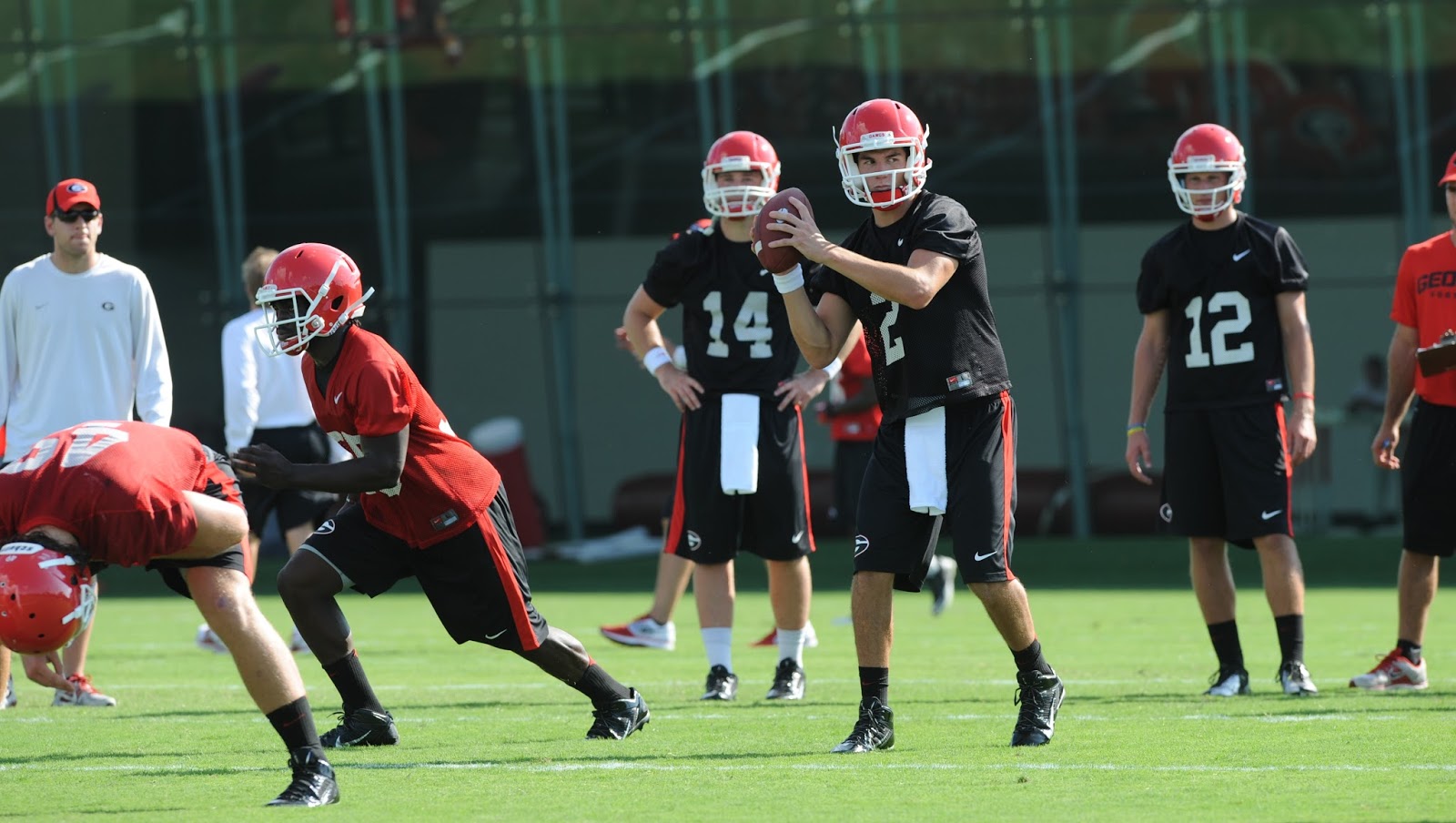
One hundred seventeen years later, Georgia's fall practice has certainly undergone some major transformations.  With no such evidence of a cow, buzz-saw, or a debating family of four, an image of one of the Bulldogs' recent practices sent by a photographer friend of mine: 


Posted by the sponsor of this blog to the site's right panel, apparently making it to the practice field recently was also a pouch of SF-7x Super FruitSpeaking of my sponsor, I've been meaning to post information on the 100% fruit, 100% natural fruit chews for some time. 

SF-7x Super Fruit is operated locally out of Athens and currently supplies its fruit chews to more than a dozen college athletic programs around the nation.  Each pouch is equivalent to two servings of fruit, USDA and NCAA compliant, a fruit source free of preservatives, added sugars, waxes and glazing agents, and  comes in three flavors--Strawberry, Raspberry, and Watermelon.

And, unlike similar products, SF-7x Super Fruit actually tastes good.  My family can attest to this: my 6-year-old is perhaps the pickiest eater on earth; however, when it comes to SF-7x Super Fruit, my wife and I literally have to hide the family pouches from him.

If you're interested in finding out more information on SF-7x Super Fruit, visit their website.  From there, you can order their products.  When ordering, make sure to enter SFATD as your promo code (ATD for "About Them Dawgs!") to receive a 10% discount off your order.

For a few of you, SF-7x Super Fruit is giving away pouches of its fruit chews.  Be one of the first three to answer the trivia question correctly below, and the company will promptly mail you a box of 15 pouches--five of each flavor.  
 

Speaking of 1896, Georgia would finish a perfect 4-0 that year, marking the first of how many seasons in UGA football history through 2012 where Georgia has gone perfect, not losing or tying a single game for an entire campaign?

A. One (1896 has been the only perfect season)
B. Three
C. Five
D. Seven
E. Nine  
 
Email your answer to Samples@patrickgarbin.com for the opportunity to receive complimentary SF-7x Super Fruit.  Please send only one answer per email address.

That was quick--had five readers promptly email and answer the trivia question correctly.  Congratulations to W. Easom, J. Blackston, R. Rivera, J. Pratt, and R. Tankersley.

Summing up Georgia's fall camp of 1896, it was reported "Athens has the football fever," and "the outlook for the Athens men is exceedingly bright" ("in spite of the lightness of the candidates").  Perhaps Athens and its "men" have actually transformed little 117 years later; the exact same things could be said of the city and its Bulldogs during the current fall practice (except the "lightness" part as the Athens men now average approximately 230 pounds per player). 

July 25, 2013

'13 Defense: Actually Better than Before?

Grantham and Garrison are pumped for 2013 
... and based on the Bulldogs' inexperienced 
defensive past, they should be.
One of my writing assignments for the newly-released DAWGTIME preseason magazine was to preview Georgia's upcoming defense—a unit deeply depleted from a year ago (as we are all fully aware).  Still, the Bulldogs' school-record seven defenders drafted into the NFL did not seem to daunt my four interviewees for the article—Garrison Smith, Ray Drew, Damian Swann, and Todd Grantham.
 
"We actually have eight guys on this year’s team who have started on defense before," Grantham was quick to point out when I brought up the fact Georgia returns just four starters from last year's unit (and really just three if you consider the top 11 defenders as far as their number of starts in 2012).  Yes, the coach is correct—eight guys return who have starting experience on the defensive side of the ball.  However, that includes Devin Bowman (1 career start), Connor Norman (2), and Malcolm Mitchell, who started three games at cornerback last year, but will presumably play only wide receiver in 2013.  
 
The bottom line is that Georgia returns just 59 career defensive starts, and from what I discovered, that is the Bulldogs' lowest returning total in 35 years since the 1978 team.
 
An additional telling statistic measuring a team's returning experience on defense, and another which is Georgia's lowest since 1978, is one utilized by the acclaimed Phil Steele in his forecasting: percentage of the returning number of tackles from the previous year.  In returning tackles from 2011, Georgia ranks 126th in the FBS, or dead last, returning players who totaled just 34.0 percent of the team's tackles a year ago.
 
How indicative is a team's percentage of tackles returning?  Well, in the FBS from 2011 to 2012, rather revealing.  I found that 16 FBS schools entered 2012 returning 48 percent or less of their tackles from the previous season.  Of these 16 teams, 10 would allow more points in 2012 than 2011, 11 yielded more offensive yards, and most importantly, just three of the 16 bettered their record from 2011.  Makes sense to me: the less tackles a team has returning, the less tacklers are coming back, rendering a more inexperienced defense which causes most defenses to be in decline from the previous season.  However, as I've presented on this blog a number of times before, Georgia is not like most teams, and its historical trending patterns seem to often go against the norm.
 
No longer the Junkyard Dogs, the inexperienced 
Wonderdog defense of '78 seemingly improved
from Georgia's defensive unit the year before.  
I soon recalled Georgia's 1978 team returning just three defensive starters from the year before, and then calculated that only 31.9 percent of the team's tackles from '77 returned.  Defensively, things looked bleak for the Bulldogs entering that season and such despair was following a losing 5-6 campaign the year before.  However, as a preseason forecast stated, "Defensive Coach Erk Russell has been known to work miracles," and miracles were indeed worked that year.  Led by an opportune defense, which allowed less than 15 points per game, the '78 "Wonderdogs" shocked the nation with a 9-1-1 regular-season mark.
 
Entering the last 38 seasons beginning in 1976, I discovered just seven instances, including 1978 and 2013, the Bulldogs returned roughly 50 percent or less of their number of tackles from the year before:
 
1978- 31.9 percent
2013- 34.0
1989- 46.1
1992- 47.1
2007- 48.3
2002- 49.5
2010- 50.6
 
Interestingly, four of the six listed campaigns above (excluding 2013) were outstanding years at Georgia—four top-11 finishes in the final AP regular-season poll.  And, for all six seasons, the Bulldogs had admirable defensive units.  I compared these six—the 1978, 1989, 1992, 2002, 2007, and 2010 at-or-less-than-50-percent-returning-tackles seasons—to their previous campaigns, and both sets averaged the exact same number of yards yielded per game (324).  Curiously, Georgia's at-or-less-than-50-percent-returning-tackles set allowed nearly less points per game (17.0 to 19.4) and most significant, averaged a better record of more than a one-game increase from the previous season (6½ games better for the six seasons combined).
 
In short, most college football defenses go into a decline in seasons when the unit would be regarded as inexperienced compared to its previous year, and rightfully so.  However, on the whole, this hasn't been the case at Georgia.  In fact, the Bulldogs' defense, and the team's overall record, tends to actually get better than before when featuring a depleted defensive unit. 
 
Historical trends aside, the Bulldogs' talent-filled defense allowed nearly 20 points and 360 yards per game last year.  Against the run specifically, Georgia gave up a staggering 182.1 yards per game and 4.1 yards per carry—both the highest averages for a Bulldog defense since 1994.  Therefore, one could argue Georgia's NFL-laden defense of 2012 was actually the most yielding of the Coach Richt era.

"A year ago, there was some talent playing behind that NFL talent; it's just that some of us didn't get to play a whole lot," Drew told me.  "Considering that, plus the depth we'll have this season, I think our defense will be just fine." 

Considering that—what Drew says—plus the fact the Bulldogs tend to buck certain trends which inhibit other teams, instead of inexperienced, Georgia's defense may very well be distinguished by another "I" word in 2013—improved.

July 20, 2013

Diary of a Dawg Night Wait-lister

As I've mentioned here a number of times before, I have limited interest in high school football recruiting.  I tend to follow a player upon him becoming a Georgia Bulldog, and not before so.  Nevertheless, I found myself intrigued a week ago with UGA's "Dawg Night," and the desire of a young man -- a Dawg Night "wait-lister," so to speak -- to perhaps become one of the fortunate ones to eventually sign with Georgia.
 
Last week, I knew little regarding UGA's Dawg Night, but was interested in what exactly a prospect experienced at the event.  The articles I discovered primarily dealt with which recruits committed to Georgia during the night, but not what they actually encountered.  I did discover a few articles with supposed inside information on some recruits' thoughts on Dawg Night, but those particular pay-site pieces were for "insiders" only -- no pay, no insight.   
 
As fate would have it, I was put in touch with the father of Shiloh High School's Cameron Stewart a few days following Dawg Night.  Cameron and his father didn't know it, but I was quite familiar with the soon-to-be junior wide receiver.  I lived in Snellville from 2003 to 2012, including covering high school sports as a correspondent for the Gwinnett Daily Post for several years.  I might know little about high school recruiting, but I still follow football in Gwinnett County rather closely.
 
I was first familiarized with the 6-foot-3, 180-pound Stewart following his defender's-hand-under-facemask, leaping catch against Meadowcreek as a mere sophomore a year ago (photo).  Cameron finished the 2012 season with 26 catches for 615 yards and 9 touchdowns.  His receiving yards were nearly half that of his entire team's; the rest of the Shiloh squad combined for less than half (four) his number of receiving touchdowns.  Nicknamed "Calvin Johnson Jr.," Stewart also runs a 4.5 in the 40, and maintains a 3.0 GPA.
 
Some sophomore highlights of Cameron:


A number of schools have come calling for Stewart, including Auburn, Oklahoma State, Vanderbilt, and Virginia Tech.  The receiver, who still has two years remaining of high school ball, has been given offers from Clemson, Georgia Tech, and Louisville.  But, so far, nothing has come from Georgia -- a school located less than an hour from his home.

This summer, Cameron has been invited to his fair share of collegiate football camps.  At one camp just prior to Dawg Night, Kipp Adams of ESPN/Dawg Nation felt compelled to tweet, "Remember this name Cameron Stewart 6'3" WR Shiloh HS."  Regardless, a few days later as far as an invite to Dawg Night, again, nothing came from Georgia.

Cameron's father, Randy, visited Georgia's "2013 Coach Richt's Football Camps" webpage and was confronted with the following: 2013 Dawg Night registration has met capacity. If you are interested in being placed on a waiting list for this camp, please call 706-542-1515 for details.  Randy called for details and was greeted with an automated message, declaring Dawg Night was filled, but if the recruit's contact information was given, he'd be placed on a waiting list.  If spots came available, Georgia would reach out to the most deserving recruits. 

A spot must have become available rather quickly because Georgia was soon in touch with Cameron, asking him to attend its Dawg Night.  The wait-lister had turned invitee in less than two hours.

Regardless of the rain and the fact one could tell which recruits were the highly anticipated, and which were the last accepted (by the jerseys the players wore -- evidently, there was a slight difference in the jersey appearance between the recruits Georgia had been expecting for some time compared to the last-minute wait-listers), Cameron had a "great time" at Dawg Night.  Prospects were first weighed and their heights measured.  After being informed about the UGA football program, the players were then divided into groups, where they underwent drills.

I just had to ask what was Cameron's favorite part of Dawg Night...  Apparently, during the drills, Stewart's performance turned the heads of both assistant Tony Ball and Mark Richt.  This wait-lister was taken aside and given unanticipated "special attention" from one who would be his position coach and the head Bulldog of them all.  Not bad for someone who wasn't even invited to the event to begin with...

Again, I might know little about high school football recruiting, but I do know my UGA football history and am quite aware of the numerous local players -- those that would turn out to be standouts for other schools -- the Bulldogs have let slip through their fingers over time.  Of course, with the abundance of talented recruits available seemingly from all over, such unawareness will inevitably result and obviously occurs at every major program. 

As I was ending my call with Randy, I asked if Georgia happened to show Cameron some interest in the near future would the star receiver suddenly be attracted to becoming a Bulldog.  "Then, UGA would definitely be in the mix!" he confirmed.  Randy then bided me farewell speaking from a restaurant in Nashville, where his son had just finished his stay as an invitee to Vanderbilt's Elite Camp IV.

Following the conversation, I was reminded of one of the reasons why I don't follow recruiting closely: it's difficult for me to comprehend why a recruit is considered a wait-lister by some, but an A-lister by others.  Regardless, and as tweeted, remember this name -- Cameron Stewart.  And, it would likely be in Georgia's best interest to remember it as well when the Bulldogs extend their initial invites next time they hold camp. 

July 11, 2013

Pulpwood (Candidly) Spoke

I wanted to announce that my newest UGA football book -- GAME OF MY LIFE Georgia Bulldogs -- has recently been printed and released by my publisher in New York.  For what it's worth, I can honestly say it is my favorite of the six book projects I have completed. 
 
As mentioned here before, I was granted permission to co-author the book with my father, and that made the project extra special.  Also, I was fortunate enough to sit down and interview 25 standout Bulldog players from the past, whose ages span from 22 to 91 years old, and not only hear about the "game of their life," so to speak, but also simply their life experiences in general, on and off the UGA campus, and on and off the football field.  

Notably, a conscious effort was made by us for the book to be different from the dozens of previous ones on UGA football by revealing the untold stories of a number of great players.  There have been many standout players in history to don the red and black, but unfortunately only a select number of them have been featured in a book.  As I asked my father at the beginning of the project, "Surely, even a punter has a game of his life, right?"   

These stories entertained us, and some made us laugh, while even a couple made us tear up.  Above all, the stories we were told educated and enlightened my father and I.  Our hope is that we were able to convey these accounts in the pages of the manuscript, giving each player their due.

Over the last few months, I've been asked several times which of the 25 interviews was my favorite.  Honestly, they were all so pleasing, but different, it's impossible for me to answer that.  However, thumbing through the book, I just caught a glimpse of what I believe was my favorite and perhaps the most meaningful quote from a player.

Pulpwood today -- no longer
with gasoline drawers on
Speaking of "different," I've blogged about Andre "Pulpwood" Smith before, including just after I interviewed him for the book.  He certainly gave a one-of-a-kind interview, especially in regards to his up-and-down life since flunking out of UGA following his one-hit wonder season of 1984.  Pulpwood was more than straightforward with me, including in explaining his circumstances while recovering in a hospital in 1997 after being shot in the back: "I had been through hell with gasoline drawers on and thought I might die," he declared.

Like the other two dozen accounts, Pulpwood's story has a happy ending.  He became a Christian, escaping his life of crime and drugs, while discovering there were people "out there from my past that really loved me."  Still, he admits, "I've actually had people, including some teammates, recently tell me, 'I thought you were dead!'"

The book is titled "Game of My Life," but it's just as much about the life experiences of those we once cheered for.  Some of these players still remain in the spotlight, whereas you may have not heard the names of others for years.  The experiences they share in the book span from one extreme to the other -- from the customary encounters to going to hell wearing gasoline drawers.

The book can be found at local bookstores and via online dealers, but your best bet, avoiding paying sales tax and inflated shipping charges, is to purchase the book directly from me at my online bookstore -- PatrickGarbin.org.  I sell my books at retail price and will ship all orders, whether you buy 1 or say 1,000 books, for 99 cents.  Plus, my co-author and I will happily throw in our complimentary signatures (especially if you were to purchase 1,000...).

July 5, 2013

Wrong Call! Wrong Call!

 If not for a couple of "gifts," (pictured L to R in '47 Sugar Bowl) Charley Trippi, Joe Geri,
"Rabbit" Smith, and their teammates perhaps would've been withheld from a perfect 1946 season.
I hope everyone had a Happy July 4th!  My holiday began yesterday with an unexpected, mid-morning phone call from an 85-year-old gentleman from Dacula, whom I'd never spoken with before.  The man said he hated to bother me on the holiday morning, but he was wondering where he could get a copy of my newest book on UGA football. (Well, with that being said, you're no bother at all, and for anyone else interested, the book can be purchased at a discount directly from me beginning early next week, but more on that, well, early next week...)
 
During our conversation, I inquired with my new friend what I often ask from those I meet who have been following the Bulldogs for many moons: What are some of your greatest memories of Georgia football?
 
The man was filled with a number of compelling stories from yesteryear, including one of assistant coach Ralph "Shug" Jordan serving as his instructor for a P.E. class at UGA during the late-40s.  "But one in particular really sticks out in my mind after all these years," he told me.  "You know, Patrick, we really got outplayed by UNC in Charley Trippi's last game for Georgia in the Sugar Bowl.  We won 20-10, but it seemed the officials were really on our side.  Afterwards, UNC raised Cain!"
 
My friend detailed the 1947 Sugar Bowl between the undefeated Bulldogs and the North Carolina Tar Heels, featuring Charlie "Choo Choo" Justice, and two questionable rulings by officials, which made a drastic difference in the bowl's scoring.  I had never heard or read of such lore, so I was all ears as the man recalled himself listening to the radio while distressing over what had been a rather one-sided affair.  That is, until Georgia caught a break, or two.
 
Midway through the third quarter, UNC led 7-0 and was looking for more before Georgia's Joe Tereshinski intercepted a pass, lateraled the ball to Dick McPhee, who sprinted more than 60 yards, nearly scoring a touchdown.  "Wrong call!  Wrong call!" evidently the unbiased national radio announcer proclaimed.  Apparently, Tereshinski's pitch was an illegal forward lateral and instead of Georgia possessing the ball deep in UNC territory, the Bulldogs should have taken over deep inside their own.  Georgia tied the score three plays later.  
 
In the fourth quarter, UNC's Ken Powell caught a 20-yard touchdown before falling into Georgia's Charles "Rabbit" Smith in the end zone.  Curiously, Powell was called for pass interference and the touchdown was negated.  With that, and for a second time, the radio announcer declared, "Wrong call!  Wrong call!"  and the Tar Heels would come away with no points.  To this day, there are a handful of UNC old timers who still wonder how a receiver can interfere with a defender, when he is in front of the defender while facing the oncoming ball.
 
The man's story of how Georgia apparently was on the "good" side of a couple of bad calls, which helped the Bulldogs capture the Sugar Bowl and, thus, complete a perfect 11-0 season, compelled me to list my opinion (and gather a few video clips) of Georgia's all-time most questionable game-deciding rulings -- official calls, whether they went against the Bulldogs or in their favor,  that likely wouldn't be made today because of instant replay or other rule changes.  

1947 Sugar Bowl: On Tereshinski's forward lateral, an official actually ran to the spot of the toss, standing there for a moment, but didn't call the return back.  On the second call in question, Powell not only caught the touchdown in front of Smith, but was then knocked out cold by the "Rabbit" and had to be removed from the field, yet the receiver was called for the interference. 
 
1965 Alabama: Trailing by a touchdown, Georgia executes one of the greatest plays in school history -- the Moore-to-Hodgson-to-Taylor famous 73-yard flea-flicker.  As noted before, common belief is that the Bulldogs got away with one because Hodgson's knees appeared to be touching the ground when he pitched the lateral to Moore.  However, the officials would claim the Georgia end never had complete control of the ball, therefore Hodgson's lateral was more like a batted ball to Taylor (therefore, his knees were allowed to touch).  Still, to some examiners of the play, Hodgson not only appears to have both knees grounded, but also seems to be in control of the ball...  
 
1968 Tennessee: Losing by eight points, Tennessee completes a 20-yard touchdown on the game's final play, and then passes for two points to "defeat" Georgia, 17-17.  The touchdown pass caught by Gary Kreis, who appeared to trap the football as he rolled over the Bulldogs' goal line, was later examined by the media, which "conclusively" decided Kreis never had control of the scoring pass. 

1984 Cotton Bowl: Quarterback John Lastinger runs for a 17-yard, game-winning touchdown against second-ranked Texas in the 1984 Cotton Bowl.  Lastinger, who was driven out of bounds while crossing the goal line, informed me for my latest book, "Honestly, I think by today's standards with instant replay, I would have been ruled out just short of the goal line."  Notably, even possessing the ball on the 1-yard line, a touchdown was no certainty for a running game, which had been dismal the entire contest, pitted against arguably the greatest defense in the history of college football.

1992 Auburn: Down by four points, Auburn attempts a running play inside Georgia's 1-yard line, but is stopped short of the goal line.  Chaos ensues as some Bulldog defenders argue for possession, others lay on top of Tiger players, all while officials somehow allow the final 19 valuable seconds to tick off the clock.  In today's sport, the Tigers undoubtedly get to run another play, maybe two.

1993 Florida: Known as "The Timeout," with five seconds remaining, Eric Zeier completes a 12-yard touchdown pass to Jerry Jerman, pulling Georgia within a point of Florida, 33-32.  But, the head linesman rules a Gators' cornerback had called timeout just prior to the snap of the ball.  The Bulldogs wind up losing the game.  Head coach Ray Goff travels to Birmingham to complain at SEC headquarters, where it is explained that as soon as an official sees a player calling timeout, as soon as he "receives it in his mind" (huh?), it's a dead play.
 
Late-90s GA Tech: The final three meetings of the 1990s between Georgia and Tech feature controversial, game-deciding plays -- two of which go in the Yellow Jackets' favor: A pass interference against Georgia Tech, leading to Georgia's game-winning touchdown in '97; Joe Hamilton's "non-fumble" in 1998; Jasper Sanks' "phantom fumble" in 1999.  Replays of the worst ruling -- Sanks' fumble -- undeniably show the Georgia back down prior to fumbling the football.  The '99 game’s officials, regarded as the best in the conference, were scheduled to officiate the following week’s SEC Championship Game until their blunder; they were suspended by the conference for their mistake.


A few others of note:
  • Florida's stolen "fumble recovery" by Jack Youngblood in 1970, totally turning around a game Georgia appeared to have clinched, coming a year after a tie in '69 when the Gators were granted an additional play resulting in a field goal as officials accused photographers  of being too close to the field. 
  • The Bulldogs' 14-13 lead over 19-point and third-ranked Alabama in '73 with less than three minutes remaining (and Georgia had the ball!) quickly turns for the worse when what should have been pass interference and then roughing the punter are not called on consecutive plays, whereupon the Tide score two touchdowns in the game's final two minutes.
  • Trailing BYU by a touchdown late in '82, a John Lastinger-to-Herschel Walker-to-Mike Weaver maneuver of pushing the ball forward under the pile after the play, barely picking up a critical first down for the Bulldogs, directly leads to a 14-14 tie and later a 17-14 victory for Georgia. 
As indicated, Georgia has certainly experienced a number of game-deciding, curious calls over the years -- some turned out good for the Bulldogs, others bad, and one from 1999 that's difficult to even think about.  Regardless, what's done is done -- "wrong call" or not.  And, as Coach Dooley said while heated debate continued days after his Georgia team was tied by Tennessee in '68 on evidently an incomplete pass, "You don't win college football games on Sunday."

June 24, 2013

The Name Game

Morocco was a two-sport star at 
UGA with a unique name perhaps 
unequaled by any other Bulldog  
You know it's the college football offseason when...
 
I was thumbing through my recently arrived Phil Steele College Football Preview, checking out Georgia's competition for the upcoming season, when I noticed a "Pig" is slated to start at one of Tennessee's wide receiver positions.
 
Sophomore Alton "Pig" Howard played some for the Vols as a freshman a year ago, including having a couple of touches at Georgia.  However, I must have missed the Pig's performance against the Bulldogs.  Surely, what has to be one of the sport's most unusual nicknames, which was given to Howard by his family when he was little because he was "fat and fast," would have caught my attention back in late September.  Nevertheless, "Pig" recently made me ponder about Georgia's Puss, Pulpwood, and the other great nicknames in the history of Bulldogs' football.
 
There have been a number of well-thought-out UGA football all-time "name" teams posted over the last several years (which seem to always be highlighted by Wycliffe Lovelace of the mid to late 1980s).  However, I've made an attempt to post Georgia football's all-time top nicknames, like Tennessee's Pig, which essentially were or became more so the players' first names.
 
The following top-10 listing was compiled from off the top of my head, so I probably omitted a few other worthy nicknames.  Please comment if you can think of any others I missed.   

1. (ZIPPY) Anthony Morocco: The Georgia halfback from 1949 to 1951 with the intriguing name would be recognized as the state's first collegiate basketball All-American and remains the only Bulldog chosen in both the NFL and NBA drafts.  The name "Zippy Morocco" was so locally acclaimed, it became the title of a song in the early 2000s by the late and distinguished folk rock singer, Vic Chesnutt.  In 2005, a book on UGA football declared Zippy got his name from his "stop and go style" on a basketball court.  Curiously, however, he recently told me for my upcoming book that he was named "Zippy" while he was a youngster, hustling to sell newspapers in Youngstown, Ohio.  "I ran around and then would sometimes jump up and hit parking signs, zipping from one place to another," he informed me.   

2. (PUSS) Hugh Whelchel: A nickname of "Puss" certainly must have signified something different during the 1920s as it does today because ineffectual and timid Whelchel was not.  From 1919 to 1922, the standout guard blocked 19 career kicks, including two which were returned for touchdowns in Georgia's celebrated victory over Alabama in 1920.  Also known as the "Dashing Douglas Blonde," the Douglas native was a two-time All-Southern selection, captain of Georgia's 1922 team, and far from what we regard today as a "puss."  Against Vanderbilt as a senior, Whelchel played much of a 12-0 defeat so "battered into semi-consciousness" that he was not aware his Bulldogs actually lost the game until well after the contest had finished.   

3. (PULPWOOD) Andre Smith: At 12 years old, Smith was asked by a recreation department coach, Walter Huckaby, how was it he could be so strong to hit towering home runs into the tops of some trees behind an outfield fence at Wheeler Park in Douglas.  Smith, who helped his father log pulpwood trees, responded with one word -- Pulpwood.  "Mr. Huckaby started calling me that, and the nickname stuck," Pulpwood informed me for my recent book.  Even Smith's two brothers' nicknames, Chainsaw and Sawdust, were derived from his logging-related nickname.  Although Pulpwood's UGA varsity career consisted of just 13 games, his sophomore campaign of 1984 (team-high 655 rushing yards, 6.0 yards per carry, and 12 receptions) remains arguably the greatest single season ever by a Bulldog who solely played the fullback position.

4. (WAR EAGLE) Harold Ketron: Lineman "War Eagle" Ketron of the early 1900s was one of the school's first star athletes.  The rugged and hard-nosed Ketron earned the nickname as a youngster as the phrase was often his battle cry with his brothers heard throughout the valleys of Habersham County.  Ketron lettered from 1901 to 1903, captaining the ’03 squad, before returning to UGA to play again in 1906 after a two-season hiatus to join his younger brother on the team -- a fellow lineman also with a unique name, Grover Cleveland Ketron.  War Eagle, who was said to spit tobacco juice on occasion in his opponent’s eye before making a tackle, would become a Georgia assistant coach and later was primarily responsible for enticing and luring one of the greatest Bulldogs of them all from the hills of Pennsylvania to Athens -- Charley Trippi.

An excellent defender against both the pass and
run, Happy sacks Kentucky's QB for a safety in '66
5. (HAPPY) Robert Dicks: Although the legend it is linked to is not completely accurate, the complete name Happy Dicks has to be one of the most fascinating and amusing in all of college football.  Besides legendary Bill Stanfill, Happy was the only other sophomore to start at least four games for Georgia's 1966 SEC championship defense.  That season, the linebacker tallied a team second-best four interceptions.  In 1968, Happy ended his playing days as a Bulldog with a total of seven career interceptions, as an integral part of a second conference title, and as a second-team All-SEC member.  Nicknamed ''Happy'' because he almost always had a smile on his face as a boy, Dicks would become a prominent and award-winning neurologist.

6. (BUM) Ashel Day: Like teammate "Puss" Whelchel, Day's nickname was nearly an injustice to the Bulldog's play on the gridiron.  The outstanding lineman on both offense and defense was certainly no bum, earning all-conference honors in 1920 and 1921.  Bum, who is also likely UGA's all-time transfer, first enrolled at Georgia Tech (since Georgia did not field a football team during World War I), where he was an All-American in 1918 and would be inducted into Tech's Sports Hall of Fame in 1984.

7. (CATFISH) Vernon Smith: Smith received his hard-earned nickname a year before entering UGA, grabbing a catfish after a classmate jokingly dared him to bite its head off.  Smith then jerked its whiskers a couple times, and with one snap, bit the fish's head clear off, including the gills.  Catfish, an end from 1929 to 1931, is still considered one of the best players in school history, becoming the second Bulldog to earn consensus All-American honors, third to be a three-time all-conference selection, and was the fourth UGA player to be inducted into the College Football Hall of Fame. 

8. The 1927 team:
Members of Georgia's "Dream and Wonder" championship team of '27 included Ivy "Chick" Shiver, Gene "Jug Head" Smith, and Robert "Bear" Morris.  Chick and Jug Head were recognized as first-team All-Southern, while Chick was also a first-team All-American.  All three players were seniors, prominent starters, and known more so by their nicknames than their first names as members of a team named national champions by both the Boand and Poling polls.  
 
Besides "Buzy," Rosenberg was also known
as "Super Frog"... just ask Coach Dooley.
9. (BUZY) Leman Rosenberg: In his first two seasons on Georgia's varsity (1970-1971), all Buzy "Don't Call Me Leman" Rosenberg tallied was eight interceptions from his right cornerback position and four punt returns for touchdowns, while being named first-team All-SEC for both campaigns.  Besides the great Scott Woerner, Buzy is the only other Bulldog to total 900+ yards on punt returns and 10+ interceptions for a career.  His 40.4 punt return average against Oregon State in 1971 (5 returns for 202 yards) remains one of the best single-game punt return averages in NCAA history, trailing leader Golden Richards of BYU (5 for 219 vs. North Texas in 1971) by less than 3.5 yards. 

10. (CHAMP and BOSS) Roland and Rodney Bailey: Separated by approximately 16 months, cornerback Champ and linebacker Boss, the two youngest of a trio of brothers who played for the Bulldogs,  are each considered one of the best at their respective positions in UGA history.  Roland was nicknamed "Champ" when he was two years old because he was an energetic child; Rodney was called "Boss" because it was the nickname of his grandfather's favorite uncle.   Besides Matt and Jon Stinchcomb, the Baileys are the only other Bulldog brother duo to both be named first-team All-American at Georgia.  Before Jarvis Jones in 2012, Champ had been the last Bulldog to finish in the top 10 of a Heisman Trophy voting (7th in 1998).
  
Honorable Mention- (OLD TUB) Lewis Green: Old Tub, a blind African-American man regarded as a "landmark" of Athens during the late 1800s, is worthy of honorable mention because he was once considered the mascot of the University and nearly represented Georgia in 1892, instead of the acclaimed goat, for the school's second football game against Auburn.  Legend had it that Green acquired the nickname when protesting his love for a "dusky maiden named Jane."  However, instead of pouring her love onto Green, Jane poured a kettle of hot water onto his head.  In desperation, Green jumped head first into a nearby tub of cold water, whereupon a young boy, Bill Christy, spotting only two large feet protruding from the tub as volumes of steam filled the air, yelled, "Hello, Uncle Tub, whose been setting you on fire?"  UGA students started using the nickname "Tub," and "Old" was later added as Green started to get up there in age.  In 1901, Old Tub passed away at 88 years old.  You can read more on Old Tub at the UGA Nickname & Mascot History page at my website.

June 13, 2013

"Terrible Terry" Was First Class

R.I.P., Joe T
I'm currently with my family on vacation, where I had sworn off posting for a week or so unless I really felt compelled to do so.  Needless to say, I instantly felt obligated to do so after hearing of the recent passing of 89-year-old Joe Tereshinski -- an All-SEC end at Georgia during the 1940s.
 
Most Bulldog followers of today are familiar with Tereshinski as the first of three generations of Georgia football players; sons Joe Jr. and Wally played during the mid-1970s, and grandson, Joe Tereshinski III, played during the mid-2000s.  Notably, each of the four Tereshinskis were members of at least one SEC championship team.  
 
Like many of Coach Wally Butts' early recruits, Tereshinski hailed from up North.  Upon his arrival to UGA in 1941, the Glen Lyon, Pennsylvania native was greeted by the southern football program with, of all things, a name change.  According to a recent article, historian Dan Magill says Tereshinski's name was changed to "Joe Terry" in game programs and nearly in university records because Butts curiously "received grief about recruiting players with long last names instead of boys from Georgia."  Nevertheless, by midseason of his sophomore campaign of 1942, Joe was back to rightfully being acknowledged as Tereshinski, although his temporary last name left a nickname lasting throughout his Bulldog playing days.
 
Deemed "Terrible Terry" because of the smashing end's outstanding blocking and tackling skills, Tereshinski was a top substitute in 1942 and upon his return from military service in 1945.  However, soon after the start of his junior year, Tereshinski became a full-time starter at right end, where he remained through Georgia's 1946 championship season.  All-Americans John Rauch, Herb St. John, Dan Edwards, and most prominently, Charley Trippi, might be the names mostly associated with Georgia's undefeated campaign of 1946.  However, if it wasn't for "Terrible Terry," the Bulldogs' perfect season might have ceased in just the third game of the year.
 
In an era when it wasn't unusual for Georgia to host early-season opponents on a Friday night, the Bulldogs welcomed 19th-ranked and undefeated Kentucky and its 32-year-old head coach, Paul "Bear" Bryant, to Sanford Stadium for a weekday night affair in mid-October.  The Wildcats, who were considered only slight underdogs, scored a touchdown on the game's opening drive and then promptly blocked a Trippi punt.  Possessing the ball 1st and 10 on Georgia's 22-yard line, Kentucky looked to take an early two-touchdown lead before encountering arguably the greatest defensive series by an individual player in UGA football history.
 
Action from the '46 Kentucky game, where "Terrible Terry"
and his teammates broke the hearts of the 'Cats and their "Bear." 
 
The Wildcats ran four plays, and on every one, Tereshinski made a "smashing" tackle at the line of scrimmage, netting a combined loss of two yards.  A few plays later, Tereshinski came through on the offensive end, catching a pass from Rauch for a gain of more than 20 yards inside the Kentucky 10-yard line.  Soon afterwards, Georgia tied the game, 7-7.  Resulting just mere minutes into the contest, Tereshinski's four consecutive defensive stops were considered what likely "turned the ballgame around" of an eventual 28-13 Georgia victory, keeping the Bulldogs' winning streak intact at eight games of what would eventually extend to 17 consecutive victories. 

The day after what was called "the best game of his career," Tereshinski made "it a full weekend," reported The Red and Black, by marrying college sweetheart and cheerleader Martha Walraven.  Following the season, he would begin an eight-year NFL career, playing offensive end, defensive end, and linebacker for the Washington Redskins.  Notably, of the first 45 Bulldogs, including Tereshinski, to play in the NFL from the mid-1920s to the mid-1950s, only one -- Hall-of-Famer Charley Trippi -- played in the league (9 seasons) longer than "Terrible Terry."

I just got off the phone with a former Bulldog player, who informed me that the terror on the field was all heart and as first class as they come off the field.  This player, who played for Georgia in the mid-1970s with Joe Jr. and Wally, was chosen in the NFL Draft following his senior year, but would be cut by the team that selected him.  A year later, believing his chances for a professional football career had already been dashed, the player received a phone call that the Redskins wanted to give him a tryout.

"'Mr. T' (Tereshinski) set up a meeting where I met Washington's GM, Bobby Bethard," the player says.  "Bethard said I would have to time 4.5 in the 40 to get signed.  I ran only a 4.65, which wasn't good enough to get invited to camp." 

A month later, this same player unexpectedly received another phone call from the Redskins, inviting him back for a second tryout.  "Mr. T was the ONLY reason the Redskins gave me a second chance to get timed," he says.  "Mr. T stuck his neck out and put in a good word for me.  He obviously had some clout with Bethard, and I will always appreciate him for trying to help me out."

The former Bulldog concludes, "Mr. T was a first class gentleman, while his two sons, Joe and Wally, are a testimony to the type of man he was for they both have always been first-class people, as well."

Perhaps more so than his play on the field while at Georgia and for the Redskins, Tereshinski will be remembered for being a first-class individual, continuing to give his loyalty and heart to a program and its players long after his playing days had finished.   

June 3, 2013

Painting the Town Red


Staying with a thorough-thrashing-of-Clemson theme...
 
I was looking through some old photos on my PC over the weekend and discovered the above sent to me by Ken Helms several months ago.  The photo depicts some offensive line play during Georgia's 35-7 rout of Clemson in 1975.  Playing center for the Bulldogs, Helms (No. 53) is joined by guard Hugh Hendrix (No. 64) and tackle Steve Wilson (No. 75).     
 
Upon receiving the photo, I recalled a story I once read regarding the lead up to the '75 Clemson game.  The Wednesday night prior to the contest, a group of UGA students ventured to Clemson and painted a good portion of the campus red.  Not to be outdone, several Tiger students returned the next night and retaliated -- and how. 
 
Tiger paws, "Clemson," and "Tigers" were painted in orange all across our beautiful campus.  The orange paint job was so thorough, UGA's Physical Plant had to resort to sandblasting the paint off instead of using customary steaming equipment.  The plant estimated it would take a whopping 200 man hours to remove all the paint.
 
On the field, the game was won by the Bulldogs primarily because of their play in the trenches.  Georgia's offensive line paved the way for 366 rushing yards, including rare 100-yard individual performances by teammates.  Bulldog backs Kevin McLee (23-103) and Glynn Harrison (16-107) each passed the century mark on the ground.  Sophomore McLee, who tied a school single-game record with four touchdowns in just his fourth varsity game, declared, "You got to give 100 percent credit to those lineman."
 
Georgia's big guys up front were handed the ultimate compliment when offensive line coach Jimmy Vickers was given the game ball following the victory.  Pessimistic Coach Dooley added, "I was honestly surprised at the way our offensive line handled Clemson."
 
As far as the painting efforts by the students of the two schools, the Bulldogs would prevail in that aspect, as well.  The UGA students who painted the Clemson campus red were never caught.  On the contrary, the Tiger painters -- four males between the ages of 20 and 22 -- would eventually be arrested for not only criminal damage to property, but also defacing an auto tag. 
 
Following their painting, the Clemson quartet was apparently heading out of town back home, when they were stopped at a road block on the edge of Athens for the tape which remain covered over their car's license plate.  Ah, the value of a good Clemson education...